


Editorial
Energy Security Through 2027: Structure Reprices Power Credit
October 19, 2026 - Energy security now prices into Latin American power credit, and capital structure, not falling rates, decides which dispatchable projects close.
Editorial


Mongolia's third neighbor policy has produced a geopolitical risk profile that reduces sanctions adjacency risk, making it approvable for Western DFI credit committees.
Sovereign credit upgrades from Fitch, Moody's, and S&P in 2024 and 2025 raised the country risk ceiling for individual bank ratings, expanding the lender universe.
Five Delphos-arranged transactions across mortgage finance, commercial banking, and fintech between 2022 and 2025 demonstrate institutional debt capacity across distinct borrower profiles.
The Bogd Bank repeat engagement across DFC, ADB, and Dutch DGGF over four years shows a Mongolian borrower can access multiple lender types in sequence.
Mongolia's instrument range, senior secured receivables facilities, fixed-rate capital markets notes, blended finance, and DFI on-lending signal institutional depth, not frontier fragility.
Mongolia’s banking sector has attracted repeat international debt capital across five closed transactions since 2022, covering mortgage finance, commercial banking, and fintech, and this blog examines why. It is written for development finance institutions and institutional allocators evaluating Mongolia as a deployment destination and argues that the deal record, read alongside the country’s sovereign credit trajectory and geopolitical positioning, reveals a market that has moved past the frontier entry phase.
The structural combination underlying repeat deployment is specific: geopolitical neutrality that Western creditors view favorably, a sovereign credit profile that has improved across three rating agencies in two years, and a borrower pool that has demonstrated it can service institutional debt across multiple facility types, placing Mongolia among the more active Emerging Markets for repeat DFI deployment in Asia.
A repeat DFI deployment pattern differs from a one-off frontier transaction in a precise way: multiple creditors, across multiple structures, return to the same market with different counterparties over a compressed time window. That pattern signals the governance standards, regulatory alignment, and client depth that credit committees require before committing a second ticket.
 Mongolia’s banking sector clears DFI credit committees because three structural conditions have converged since 2022: a third neighbor foreign policy that reduces sanctions adjacency risk, sovereign credit upgrades from Fitch, Moody’s, and S&P that have raised the country risk ceiling, and Basel II alignment progress that gives governance-focused creditors a credible compliance trajectory.
The combination matters because each condition addresses a different objection at the approval stage. Geopolitical neutrality removes the sanctions screen. Sovereign upgrades raise the ceiling from which individual bank ratings are derived, expanding the investable universe. Governance reform gives capital providers a compliance trajectory they can model over a facility tenor. Mongolia does not clear credit committees despite its frontier characteristics. It clears them because of a specific structural configuration that has developed since 2022.
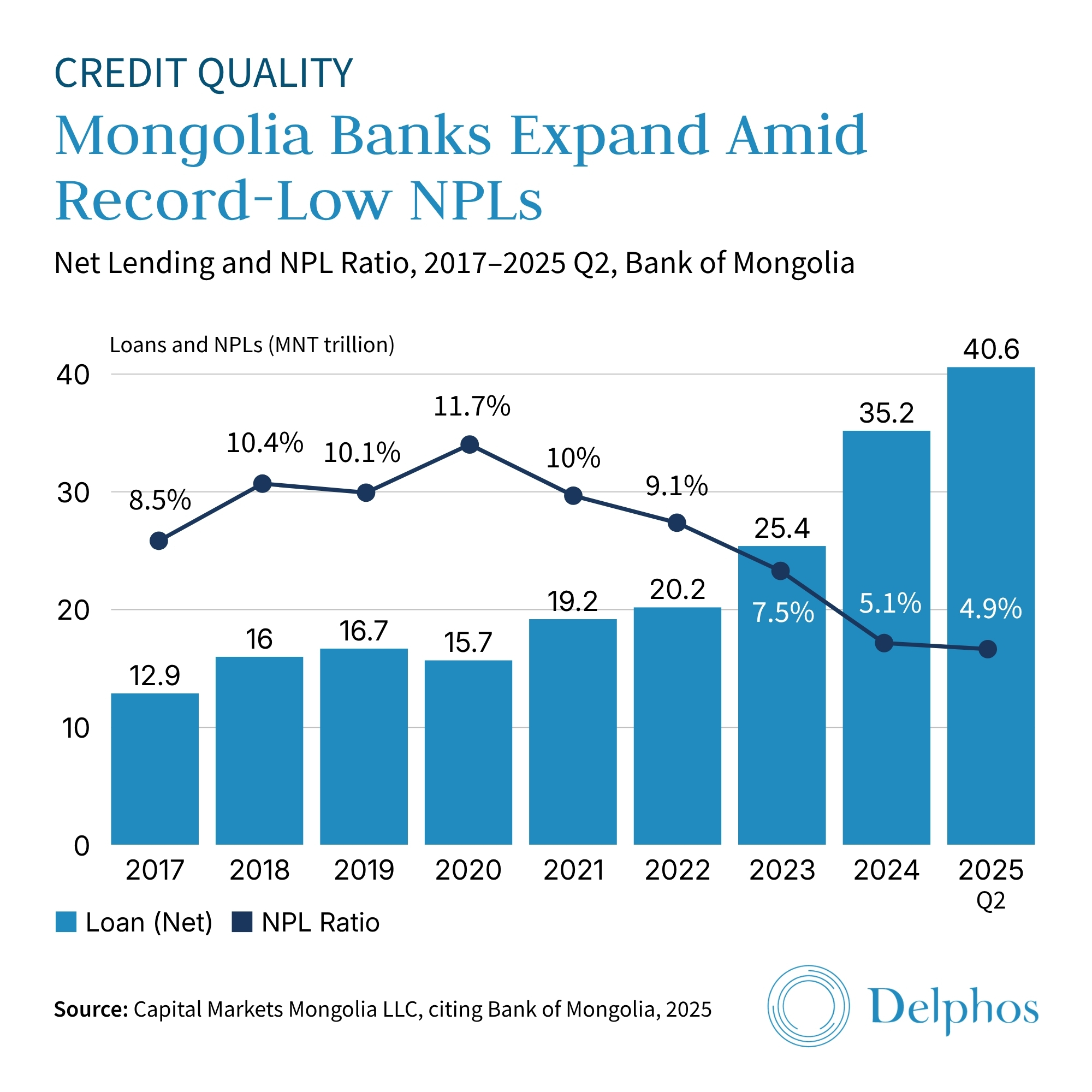
The four largest commercial banks, including Khan Bank, Golomt Bank, and two other banks, collectively held approximately US$16.5B in total assets as of December 2024, representing 79.87% of the financial sector. Non-performing loans declined from 7.4% in December 2023 to 5.1% in December 2024, a 27% improvement that held even as credit volumes expanded. A detailed overview of Mongolia’s financial sector fundamentals and digital banking trajectory provides the regulatory context for the transaction record examined here.
Mongolia’s multi-vector foreign policy, sustaining active relationships with Russia, China, and a broad coalition of Western partners simultaneously, has produced a sanctions adjacency profile that is materially cleaner than most economies operating in the same geographic corridor. Bilateral partnerships with the United States, European Union members, Japan, and South Korea give foreign banks and multilateral creditors confidence that Mongolia will not be drawn into a sanctions perimeter through political alignment. Foreign direct investment has followed: regional economic integration without political entanglement is rare in the post-2022 environment and is now a genuine input into credit committee approvals.
Fitch upgraded Mongolia’s rating from B to B+ in September 2024, its first upgrade since 2015, projecting average GDP growth of 6% from 2024 to 2026. Moody’s followed with an upgrade to B1 in October 2025, citing fiscal discipline and progress on governance reform as primary drivers. S&P moved Mongolia to BB- in October 2025, its highest rating in 13 years. Each upgrade raised the sovereign ceiling from which individual bank ratings are derived, expanding the range of institutional capital deployable into institutions in the market. Two of Mongolia’s largest commercial banks established BNY Mellon correspondent relationships in 2024. The Bank of Mongolia has advanced Basel II alignment across the sector.
Between 2022 and 2025, the firm arranged five deals in the Mongolian financial sector across three borrower types, covering mortgage finance, commercial banking, and fintech, and four lender categories: DFC, ADB, the Dutch DGGF, and private credit. Deal sizes ranged from US$15MM to US$150MM, with a combined value exceeding US$308MM.
The five facilities span distinct dimensions of Mongolia’s institutional capacity: whether a mortgage institution could absorb long-duration DFI debt, whether a commercial bank could access capital markets for green finance, whether a fintech platform could meet institutional credit requirements for a receivables-backed facility, and whether the same institution could return to the market across different creditor types over four years. Reviewing the top 10 Emerging Market deals that defined 2025 places the Mongolia record in context: few frontier markets generated comparable transaction frequency across multiple borrower types in a single four-year window.
“We have structured mortgage finance, commercial banking, and fintech facilities in Mongolia since 2022. Each structure required a different approach. Each one closed.” – Bart Turtelboom, CEO of Delphos.
All three engagements are domiciled in Mongolia, each representing a distinct client profile with different structuring requirements:
These two Bogd Bank engagements involve the same institution across different lender types, demonstrating repeat access over four years:
The Bogd Bank sequence, DFC in 2022, ADB blended finance, then the Delphos Securities private placement, is the most direct evidence that a Mongolian commercial bank can access multiple lender types over a sustained period. ADB has committed US$4.5B to Mongolia across 390 transactions to date and launched a new Country Partnership Strategy for 2025 to 2028.
 The market can absorb senior secured receivables facilities, fixed-rate capital markets notes, blended finance packages combining concessional and commercial debt, and DFI on-lending structures simultaneously. That instrument range is the primary indicator of market depth: a frontier market that can service only one instrument type is not ready for successive institutional deployment.
For allocators assessing what debt raising in Emerging Markets requires from institutional creditors, seven green and social bond transactions have been issued in Mongolia since 2021, raising a total of US$338MM across domestic investors and international markets. The World Bank Group’s IFC invested up to US$100MM in Khan Bank’s social bond in July 2024, Mongolia’s first, structured under ICMA Social Bond Principles with proceeds directed to MSMEs, women-owned businesses, and underserved rural communities.
LendMN needed a receivables-backed, senior-secured structure because the underlying asset base, digital consumer loans from fintech companies, required ring-fencing to meet institutional credit requirements, with FX risk mitigation built in to mitigate national-currency revenue exposure. Bogd Bank’s fixed-rate notes issuance required capital markets access, ICMA-aligned documentation, and green finance certification: a different preparation timeline, a different creditor category, and a different execution process. Instrument selection in Mongolia is a structuring decision, not a default.
The ADB facility for Bogd Bank demonstrates that borrowers in the market can access concessional and impact-linked capital when the on-lending portfolio meets the required targeting criteria. Directing 70% of a facility to women-led MSMEs and 30% to green finance within a single blended structure, contributing to inclusive growth across Mongolia’s economy, requires governance systems, reporting infrastructure, and portfolio segmentation that most early-stage markets lack. The sector has demonstrated all three.
 DFI credit teams and financial institutions assessing borrowers in the sector run four variables before committing capital: currency exposure and FX mitigation structure, Basel II compliance trajectory, existing DFI lender relationships and performance history, and on-lending portfolio quality by segment. Each of these variables has a documented answer across the five closed deals.
Mongolia’s banking sector total assets reached 71.2 trillion MNT by the end of 2024, representing 77.1% of the entire financial sector, a concentration that makes due diligence on a meaningful share of the market achievable within a standard pre-investment timeline. The sector is large enough to absorb institutional tickets, concentrated enough for due diligence to be tractable, and documented enough, across five closed mandates, to give incoming creditors a performance reference before committing capital.
Three questions recur at the approval stage for transactions in this market:
The Bogd Bank engagement sequence gives incoming creditors a four-year performance reference across three creditor types, a due diligence input that did not exist in 2022.
Currency risk in Mongolia’s debt is real: the national currency has experienced depreciation pressure linked to natural resources export cycles, and most international facilities are denominated in foreign currencies. The LendMN transaction addressed this through embedded FX mitigation; the MIK facility addressed it through term alignment, matching long-duration funding with long-duration mortgage assets. For allocators planning capital deployment strategies for the next cycle, two of Mongolia’s largest commercial banks now hold BNY Mellon correspondent relationships, Basel II alignment is in progress, and facilities across the US$15MM to US$150MM range have closed and performed across a four-year window.
Mongolia’s banking sector has moved past the frontier entry phase, but lender composition, instrument selection, and borrower due diligence still require a partner with transaction history in the market. Delphos provides Capital Raising and Transaction Advisory for borrowers and creditors across Mongolia and Central Asia, from DFC senior debt to capital markets notes to fintech receivables facilities, drawing on a closed transaction record spanning five deals and three borrower types between 2022 and 2025.
Three structural factors support repeat deployment: geopolitical neutrality that reduces sanctions adjacency risk, consecutive sovereign credit upgrades from three rating agencies in 2024 and 2025, and a closed transaction record across mortgage finance, commercial banking, and fintech since 2022. Repeat deployment is evidence of market maturity.
Between 2021 and 2025, the active instrument range has included DFI senior debt, blended finance facilities combining concessional and commercial capital, fixed-rate capital markets notes issued under ICMA standards, and senior secured receivables-backed structures for fintech borrowers. That breadth across instrument types is itself the evidence of market depth.
Mongolia's multi-vector foreign policy, sustaining active relationships with Russia, China, and Western partners simultaneously, has produced a geopolitical risk profile that international creditors view favorably compared to regional alternatives. It reduces sanctions adjacency risk while preserving access to regional trade flows, a combination that improves DFI credit committee approvability without requiring political alignment.
Fitch upgraded Mongolia to B+ in September 2024. Moody's upgraded to B1 in October 2025 and S&P moved Mongolia to BB- in October 2025, its highest rating in 13 years. Each upgrade raised the sovereign ceiling from which individual bank ratings are derived, expanding the institutional creditor universe.
DFC, ADB, IFC, and private credit providers, including Lendable, have all deployed capital in Mongolia's financial sector as of 2024 and 2025. ADB has committed US$4.5B across 390 transactions to date and launched a new Country Partnership Strategy for 2025 to 2028.
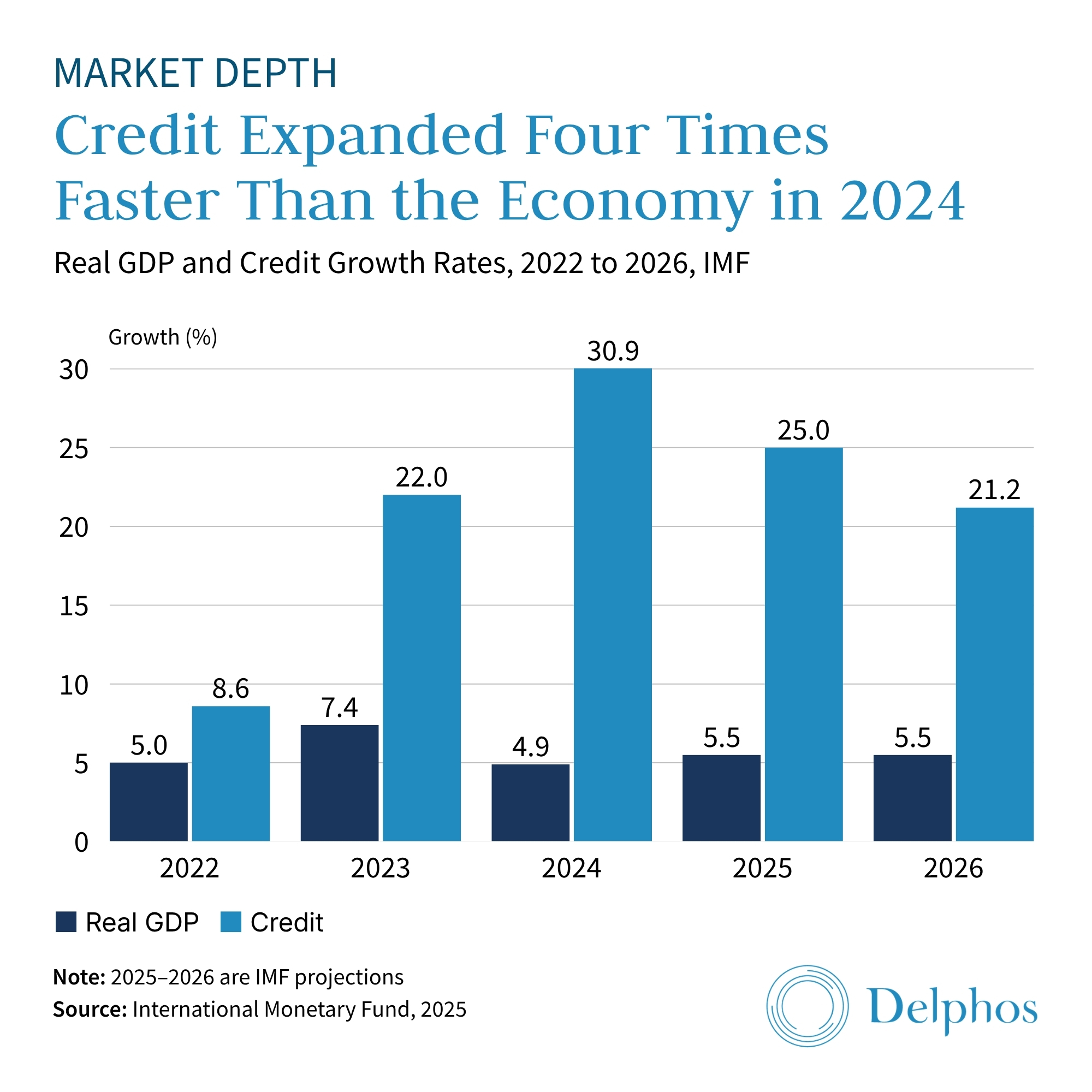
NPLs declined from 7.4% in December 2023 to 5.1% in December 2024. That improvement occurred alongside 30.9% credit growth in 2024, confirming that portfolio quality held as loan volumes expanded, a combination that credit committees weigh favorably.
International creditors access Mongolia's banking sector through bilateral DFI facilities, syndicated lending, capital markets issuances under ICMA standards, and private credit platforms deploying senior secured structures. Channel selection depends on borrower type, facility size, and on-lending portfolio composition.
Editorial
October 19, 2026 - Energy security now prices into Latin American power credit, and capital structure, not falling rates, decides which dispatchable projects close.

Editorial
October 12, 2026 - Mining finance in Latin America turns on capital structure and market selection, not price, when copper projects reach financial close.

Editorial
October 5, 2026 - Tariff access and near-shore capture reordered the 2026 Emerging Markets ranking, making bankability rather than forecast returns the deciding measure.
Discover Delphos' premier capital raising and financial advisory services, making an impact across five continents.
Learn More
Reach out to us to enhance your impactful business in private emerging markets by Delphos' tailor-made financial advisory and capital raising service.
Learn More
Delphos arranges capital raising (debt and equity) and transaction advisory for emerging-market project sponsors and operating corporates across Africa, Asia, Latin America and the Caribbean, and Emerging Europe.
Thank you for submitting the form. Our team will reach out to you soon.
In the meanwhile follow us on LinkedIn to get inspired daily.
Visit LinkedIn
We appreciate your interest in Delphos!
Could you let us know how you discovered us?
We are here to help. Reach out to schedule an introductory call with one of our team members and learn more about how Delphos Cybersecurity can benefit your organisation.

Tell us a bit about your needs so we can match you with the right advisor.

Stay ahead on impactful stories and industry trends in private emerging markets - the knowledge you need is just a click away.
We appreciate your interest in Delphos!
Could you let us know how you discovered us?


