


Editorial
Best Emerging Markets to Invest in 2026: How Tariffs Redrew the Map
October 5, 2026 - Tariff access and near-shore capture reordered the 2026 Emerging Markets ranking, making bankability rather than forecast returns the deciding measure.
Editorial


A development lender anchors the borrower it can defend to its own risk committee, not the one with the highest projected returns.
DFI financing shifts the first screening question from financial terms to country risk, which sponsors answer with quantified evidence or not at all.
AI readiness is a trait of the evidence, not a tool: structured, source-linked data that a screening model reads without human help.
A single DFI financing ticket mobilizes commercial lenders behind it, which is why the lead ticket matters more than its size suggests.
Meeting a lender's terms and qualifying for DFI financing are different tests, and the gap shows up in months to the term sheet.
DFI financing gives sponsors in Emerging Markets a longer tenor, a lower cost of debt, and a lead investor that commercial lenders follow. This guide sets out the positioning sequence for sponsors at small and medium-sized enterprises (SMEs), corporates, and developers, from capital structure through to the investment memo. The screen that decides now runs on artificial intelligence (AI) applied to geopolitical models, so the work happens before the first approach, not during it.
A development finance institution is a government-backed or multilateral lender that finances private projects in Emerging Markets on commercial terms while pursuing an economic development mandate. DFI financing becomes DFI-anchored debt when that institution takes the lead position in a facility and mobilizes a commercial syndicate behind it.
 Four tests decide access to DFI financing. A development lender checks mandate fit first, then whether the capital structure leaves room for it to lead. Country risk comes next, put in numbers and not just described, followed by the evidence in a form its screening models can read. Pricing comes last.
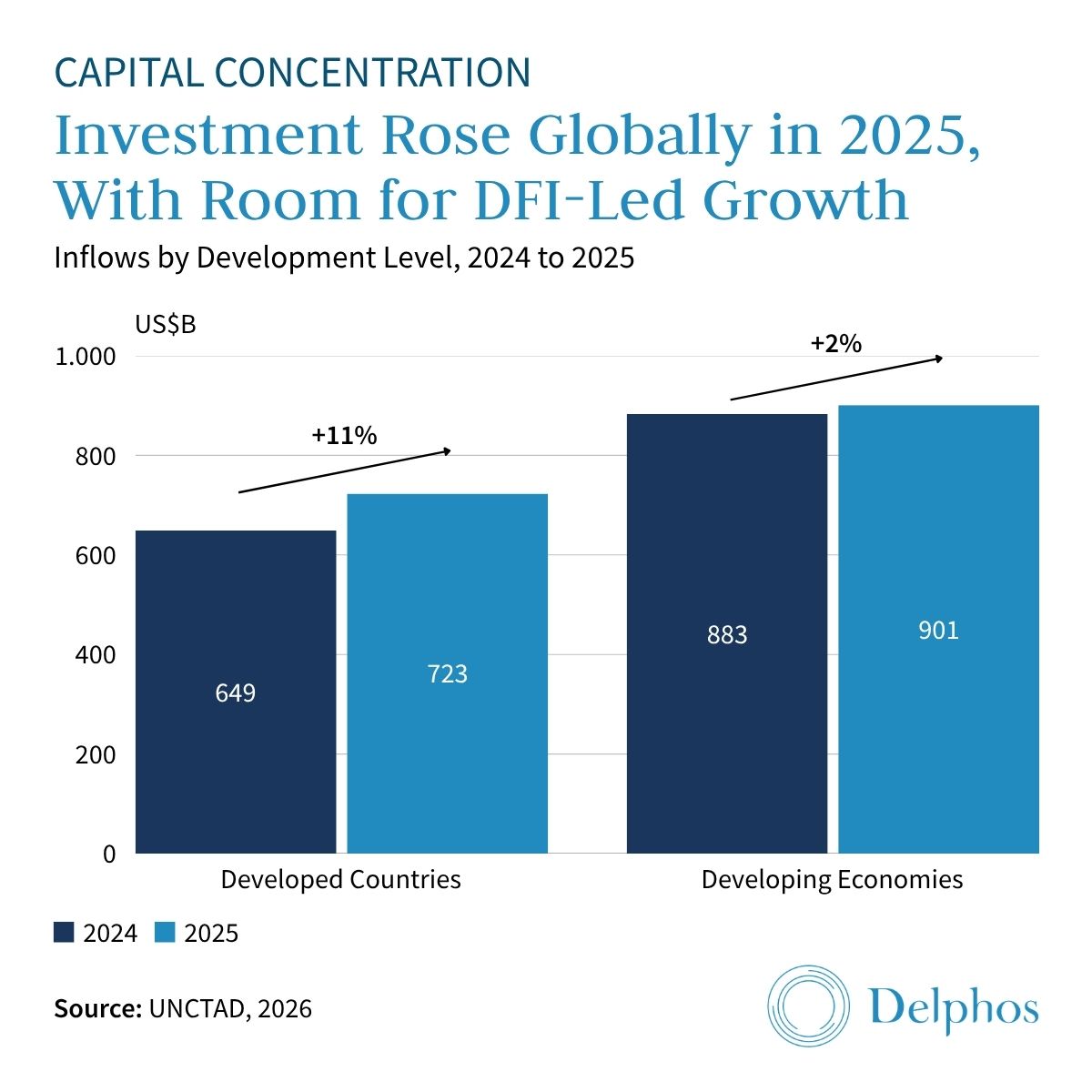
Global foreign direct investment rose 6% to US$1.6T in 2025, and the gain went to developed economies at US$723B against US$901B across developing economies. The capital exists. It does not arrive where development needs it, which is the gap anchored institutional debt was built to close. The annual Sustainable Development Goal financing gap runs at roughly US$4T, and reaches US$6.4T by 2030 without reform.
Geoeconomic confrontation ranks as the top global risk for 2026, named by 18% of respondents as the most likely trigger of a material crisis. That ranking reaches the underwriting room before it reaches the news. Capital moves toward markets that have re-rated, a pattern visible in Southeast Asia capital raising. For sponsors elsewhere, this financing route closes the gap.
A DFI committee approves exposure it can defend against its own mandate and its own loss record. The record reads better than its reputation. Across the multilateral development bank (MDB) and DFI system, loans to more than 10,000 private entities averaged a 3.54% default rate from 1994 to 2024. That is close to the rate for private firms in advanced economies.
The question is not whether Emerging Markets perform. It is whether this borrower’s file proves it on paper. That standard sits above what lenders require at a commercial bank, and clearing it is what separates DFI financing from an ordinary bank credit file.
DFI financing and commercial bank debt price the same borrower differently. Infrastructure contracts in the Global Emerging Markets Risk Database (GEMs) sample carry a cumulative default rate of 19.4% against 14.8% for other sectors. A commercial credit committee treats that spread as a ceiling. A development lender treats it as a mandate.
The table compares the two routes on the terms that decide which one a sponsor takes.
Dimension | DFI-Anchored Debt | Commercial Bank Debt |
| Tenor | Long-term, matched to asset life | Shorter, refinancing risk sits with the borrower |
| Political risk cover | Available through guarantees and insurance products | Rarely offered, priced in or left out |
| Crowd-in effect | Lead ticket pulls a commercial syndicate in behind it | No signaling effect on other creditors |
| Country-risk tolerance | Mandate covers markets banks step back from | Internal country limits cap or block exposure |
| Pricing | Concessional layers where impact tests are met | Fully market-priced |
| Access in downturns | Counter-cyclical by design | Contracts when spreads widen |
 Structuring for DFI financing means leaving the senior long-tenor position open for a development financier and placing commercial tranches behind it on subordination and tenor. Pair that with a country-risk view priced inside the model, not told as a story in an appendix. The stack has to show where the first institutional ticket sits and what follows it.
The senior slot is the one worth designing around. MDBs and development finance institutions mobilized US$108.7B in private finance for middle-income and low-income countries in 2024, up 24% year on year. Almost none of it arrived without a lead ticket to follow. A stack that fills its senior tranche before approaching an institution removes the role DFI financing is there to play.
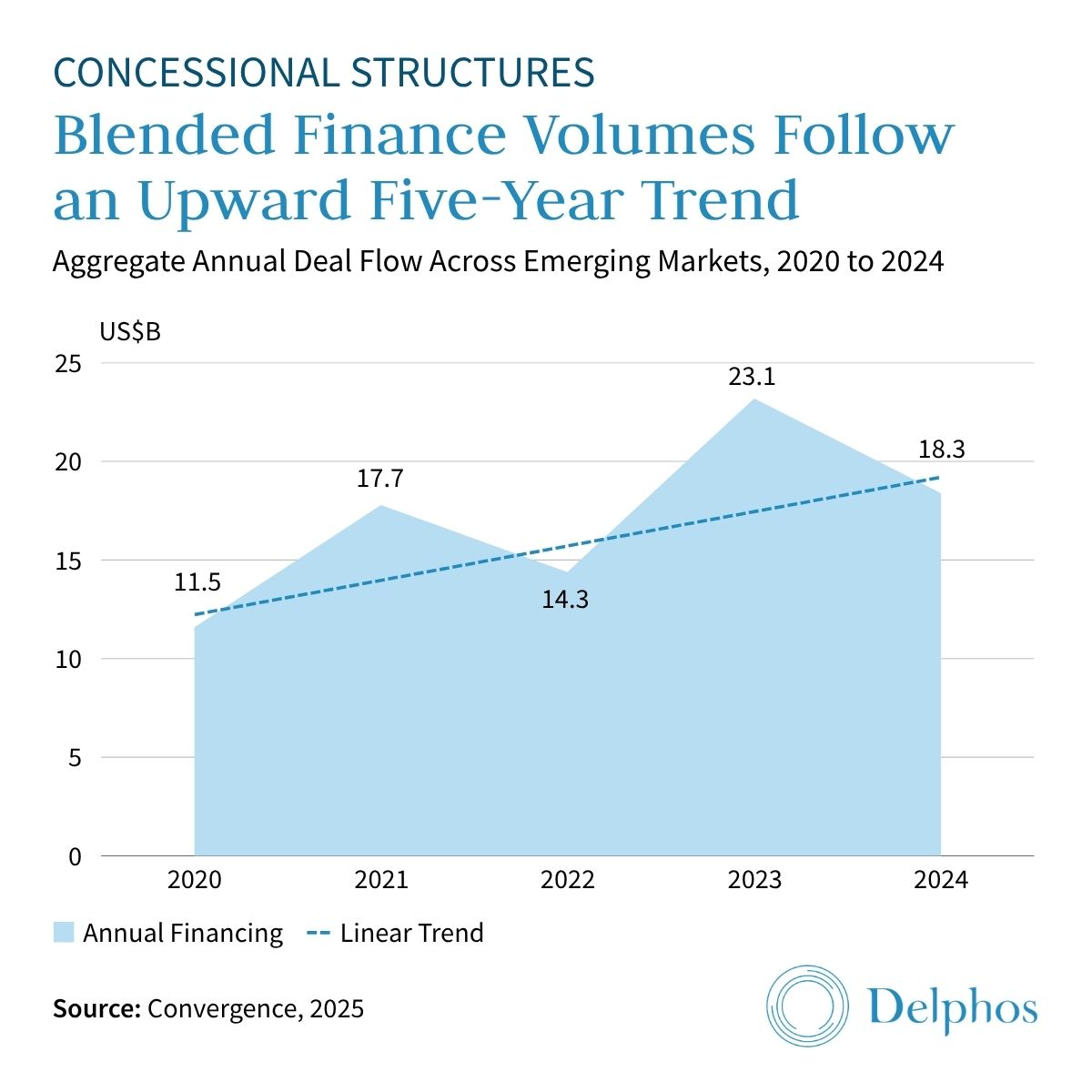
Two instruments do the work at the tranche level. Concessional finance absorbs early risk in a first-loss or subordinated layer, which is how 123 blended finance transactions reached close in 2024 for a combined US$18.3B. Guarantees do the same work from the other side, and the World Bank Group is targeting US$20B or more in annual issuance by 2030.
Scale is not the constraint on DFI financing. The U.S. International Development Finance Corporation (DFC) committed a record US$12.1B across more than 180 transactions in FY2024 and holds a combined exposure of US$48.9B. What puts a sponsor inside that book is a stack that gives the institution a place to sit.
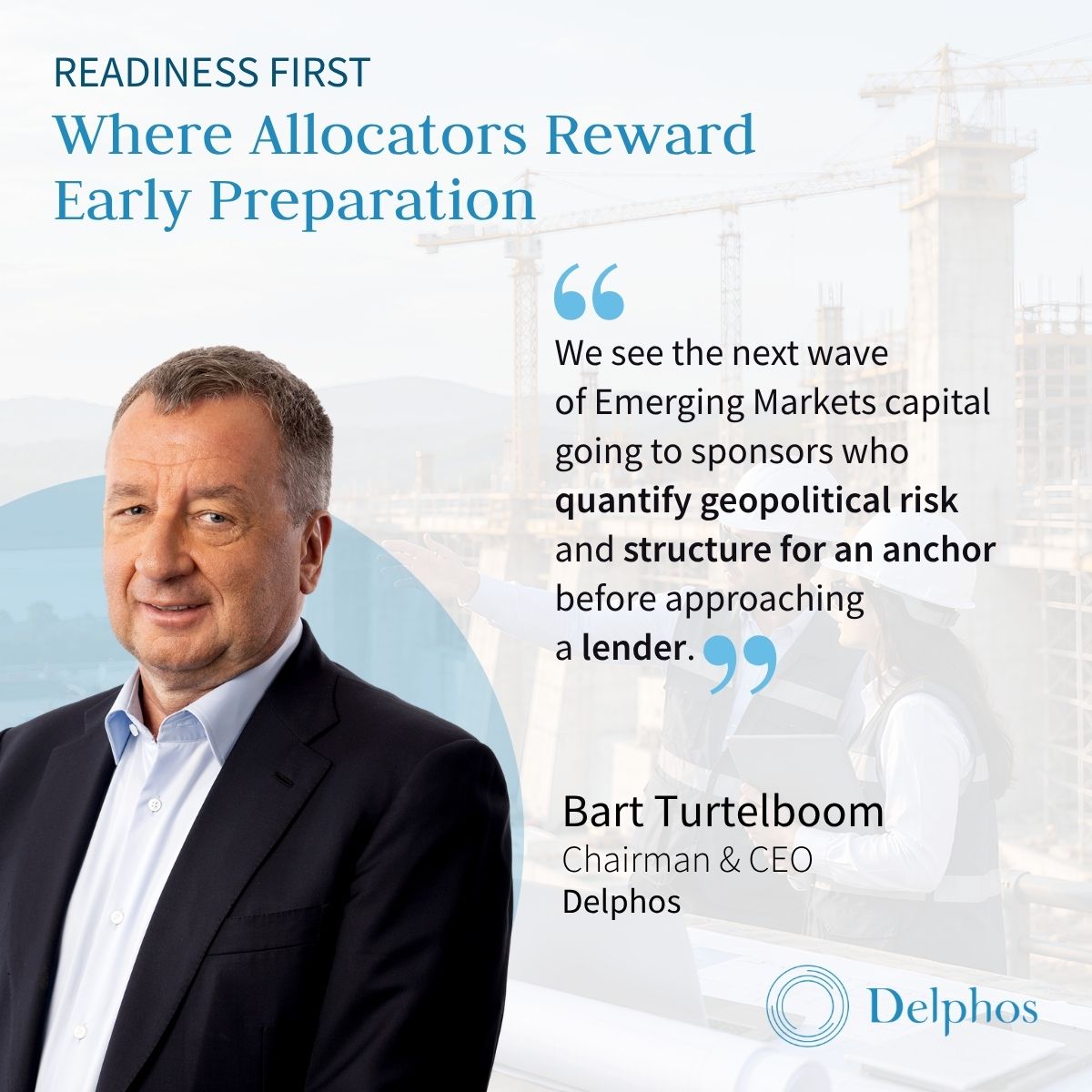
“In the transactions we structure, a development finance institution commits once it can defend the borrower to its risk committee, and that defense is built before the term sheet.” – Bart Turtelboom, Chairman & CEO of Delphos.
Geopolitical exposure has a price inside DFI financing. That price can be measured. International Monetary Fund (IMF) modeling puts the effect at 15%. A one-standard-deviation rise in tension between two countries cuts bilateral cross-border portfolio and bank capital allocations by that margin.
That work belongs inside the financial model. A sponsor who has run transfer and convertibility scenarios, offtaker concentration, and sanctions exposure hands the screen a number instead of an argument. Country risk that moves a base case, a downside, and a stressed case produces a range a credit team can underwrite. Political risk cover then prices against that range, which is where guarantees stop being extras and become part of the facility itself.
An AI-ready memo is structured, source-linked, and machine-readable. Every claim maps to a document, every document sits in a labeled data room, and every number traces to its source without a person bridging the gap. The screen reads the file directly. In DFI financing, readiness is a trait of the evidence, not of any tool a sponsor buys.
Automated review is already in the loop. Credit risk falls measurably as AI adoption rises, and the effect is stronger in major emerging economies than in advanced ones. AI underwriting now shapes the first pass on a file, and DFI financing feels that shift earlier than commercial credit does.
Order is what the model can read. A memo that answers each creditor question in a named section, with the supporting document linked from that section, turns a two-week diligence loop into a same-week response. That discipline sits behind the 2026 data room standard, and it is where most of the timeline is won or lost.
Institutional investors named geopolitical exposure their top concern in 2025, at 41% of respondents. A file that answers that concern in labeled form removes the largest single reason a DFI financing screen stalls.
Deal flow has held. International project finance deal numbers in developing economies fell only 2% in the first half of 2025, against an 8% decline in global project finance value. Transactions are still reaching close. The constraint sits in the evidence, not in appetite.
Global financial assets total roughly US$461T. The formal micro, small, and medium enterprise (MSME) finance gap in Emerging Markets stands at US$5.7T, with demand of US$10.3T against supply of US$4.6T. Capital and demand are both present. What sits between them is the quality of the file, the same point investor due diligence reaches from the creditor side.
A term sheet follows a screen that could not find a gap, and sponsors shorten the path to DFI financing by front-loading the answers. Mandate fit sits on the first page, and the model carries the country-risk quantification. The data room already holds what a DFI opens first: audited financials, offtake contracts, environmental and social assessment, governance records, and the ownership chain. The timeline shortens because the back-and-forth never starts.
 Three transactions show DFI financing working across three regions and three sectors, each with a development lender or a large institutional creditor at the front.
MIK (Mongolian Mortgage Corporation LLC) closed in 2025 as a US$150MM DFC financing structured as the acquisition of mortgage-backed securities. It remains the largest DFC financing in Mongolia to date and a direct DFC-anchored facility.
The same senior debt structure applied in West Africa produced Wave, a EUR€90MM senior debt raise for a fintech company in Côte d’Ivoire and Senegal. That facility crossed into a different region and a different sector.
Applied to infrastructure, the same logic produced MPC Energy Solutions, a US$34MM non-recourse project financing for a solar photovoltaic plant in Guatemala in 2024.
Across Asia, Africa, and Latin America, the pattern holds. The fuller track record sets out the transactions behind it.
Commercial capital is concentrating in developed markets while the DFI financing screen tightens, and the sponsors who position early reach a lead commitment first. Delphos builds the capital structure and the financing memo that meet what a development lender needs, then mobilizes a commercial syndicate behind the lead ticket. Capital Raising arranges the debt and Transaction Advisory tests the stack against the questions a DFI will ask, drawing on more than US$20B mobilized across 600-plus transactions. The company works with SME sponsors, corporates, and developers in Emerging Markets preparing an institutional raise around DFI financing.
Begin with an investment readiness assessment, then build the raise around a DFI anchor →
A government-backed or multilateral lender that finances private projects in Emerging Markets. It lends on commercial terms while pursuing a development mandate, which lets it take positions commercial banks will not lead alone and de-risk transactions enough for others to join.
Yes. Established SMEs with three to five years of operations qualify regularly. Eligibility turns on a defensible capital structure, quantified risk, and a screen-ready memo, not on balance sheet size. Mandate fit and development impact carry weight alongside the financial case.
Preparation moves the number more than luck does, though timelines vary by institution and instrument. Machine-readable evidence and pre-empted country-risk questions cut the back-and-forth at screening, which is where most of the delay accumulates. A well-positioned borrower shortens the path materially.
Concessional and commercial capital sit inside one structure. The concessional layer absorbs early risk, which lets commercial lenders enter at better terms than they would offer alone. The pricing gain comes from that risk transfer, not from subsidy.
The institution takes a lead or first-loss position that signals diligence quality and reduces the risk others carry. Guarantees and political risk cover extend that comfort further. Crowding in is the multiplier: the facility mobilizes capital well beyond the institution's own ticket.
Unaddressed exposure does. Quantified mitigation narrows the premium, because the screen prices evidence, not headlines. Measured default rates across development lender portfolios in Emerging Markets sit below what perception suggests, and a borrower who documents that gap argues from data.
Editorial
October 5, 2026 - Tariff access and near-shore capture reordered the 2026 Emerging Markets ranking, making bankability rather than forecast returns the deciding measure.

Editorial
September 21, 2026 - Telecom financing in frontier markets closes when one US$ instrument prices currency, tenor, and geopolitical risk inside a single structure.

Editorial
September 10, 2026 - Energy project finance in MENA now turns on project preparation, because capital is available while bankable, system-ready assets remain scarce.
Discover Delphos' premier capital raising and financial advisory services, making an impact across five continents.
Learn More
Reach out to us to enhance your impactful business in private emerging markets by Delphos' tailor-made financial advisory and capital raising service.
Learn More
Delphos arranges capital raising (debt and equity) and transaction advisory for emerging-market project sponsors and operating corporates across Africa, Asia, Latin America and the Caribbean, and Emerging Europe.
Thank you for submitting the form. Our team will reach out to you soon.
In the meanwhile follow us on LinkedIn to get inspired daily.
Visit LinkedIn
We appreciate your interest in Delphos!
Could you let us know how you discovered us?
We are here to help. Reach out to schedule an introductory call with one of our team members and learn more about how Delphos Cybersecurity can benefit your organisation.

Tell us a bit about your needs so we can match you with the right advisor.

Stay ahead on impactful stories and industry trends in private emerging markets - the knowledge you need is just a click away.
We appreciate your interest in Delphos!
Could you let us know how you discovered us?


