


Editorial
Lobito Corridor Financing: A Structuring Map for Sponsors
November 9, 2026 - The Lobito Corridor shows how structure and route security, not commodity price, decide which African critical minerals projects reach close.
Editorial

For companies expanding into high-growth economies, Emerging Markets cybersecurity has shifted from a technical issue. It is now a core business risk management challenge. Cyber incidents have grown by roughly 21% annually worldwide. Upper-middle-income countries are seeing a sharper 37% increase. This reflects how rapidly digital exposure is rising in Emerging Markets. Moreover, digital transformation is also accelerating faster than cybersecurity governance and compliance requirements. This is creating material vulnerabilities across data and infrastructure for investors and businesses alike.
Cybercrime damages are projected to reach US$10.5 trillion in 2025. Yet only around half of Emerging economies have comprehensive data-protection legislation in place. In practice, the weakest link is often security. However, digital risk management and enterprise risk management are still treated as regulatory compliance. They are rarely designed as operational security functions, even as cyber risk rises with cross-border data exposure. For business entrants, data security becomes a commercial constraint. As a result, this dynamic becomes more pronounced as digital transformation accelerates cross-border data flows.
Against this backdrop, a credible cybersecurity strategy for Emerging Markets is no longer optional. It is foundational to resilience, valuation, and market access.
“A cybersecurity strategy for Emerging Markets can no longer be treated as a technical afterthought. For companies expanding into high-growth economies, cybersecurity is now a core pillar of operational resilience, investor confidence, and long-term value creation.” – Bart Turtelboom, CEO of Delphos.
 Key Controls for Emerging Markets
In jurisdictions where national cyber frameworks remain uneven, businesses must compensate through internal discipline. Strong identity, security, and access management, multi-factor authentication, and security oversight are essential first steps to protect sensitive data and core data operations. This is particularly critical for SME organizations, where weak oversight, immature risk management, and limited digital risk management resources and skills gaps increase exposure. These controls should be treated as baseline risk management, not optional “IT hygiene”. At a minimum, organizations should tighten user accounts, formalize access controls, and adopt a zero-trust architecture that continuously validates authentication for all users, helping to control access and protect core software, network, and internet-facing systems.
System hardening remains one of the most cost-effective security measures. However, many Emerging-market organizations still rely on legacy infrastructure alongside modern systems. As a result, the attack surface expands and security risk increases. Moreover, disabling unnecessary services, enforcing patch management, and standardizing baseline security controls can reduce exploitation by over 30%, according to World Bank Group analysis. These measures are crucial to any scalable cybersecurity strategy for Emerging Markets.
The rapid adoption of cloud computing and AI is reshaping operational models across Emerging Markets. It is also magnifying the risk. Misconfigured assets in cloud environments are now among the most common causes of breaches. This exposes gaps in cloud security and weakens any cybersecurity strategy for Emerging Markets. In high-growth expansions, digital risk management must clearly define responsibilities between internal teams and cloud providers. Accountability typically sits with the operator’s risk management framework. Artificial Intelligence–enabled phishing and automation are also increasing attack sophistication. These trends contributed to nearly a quarter of major cyber losses in emerging economies last year.
For organizations, the practical response is repeatable cloud controls. This includes cloud governance, identity, and access. It also includes secure configuration, logging, monitoring, and encryption. Key management, segmentation, backups, recovery, and audit trails must run consistently across business units and data platforms.
By 2025, most companies in high-growth sectors will rely on cloud computing for critical functions. Yet fewer than half embed security by design from the outset. A resilient cybersecurity strategy for Emerging Markets, therefore, requires closer alignment with cloud providers. It also requires continuous monitoring and clearer accountability under shared responsibility models. Without continuous monitoring, misconfigurations can persist undetected. This increases exposure to data breaches, advanced threat activity, and exploitable vulnerabilities.
For companies expanding into high-growth economies, cyber exposure tends to concentrate around a small number of recurring risk patterns. By 2026, the most material cybersecurity risks in Emerging Markets are expected to include:
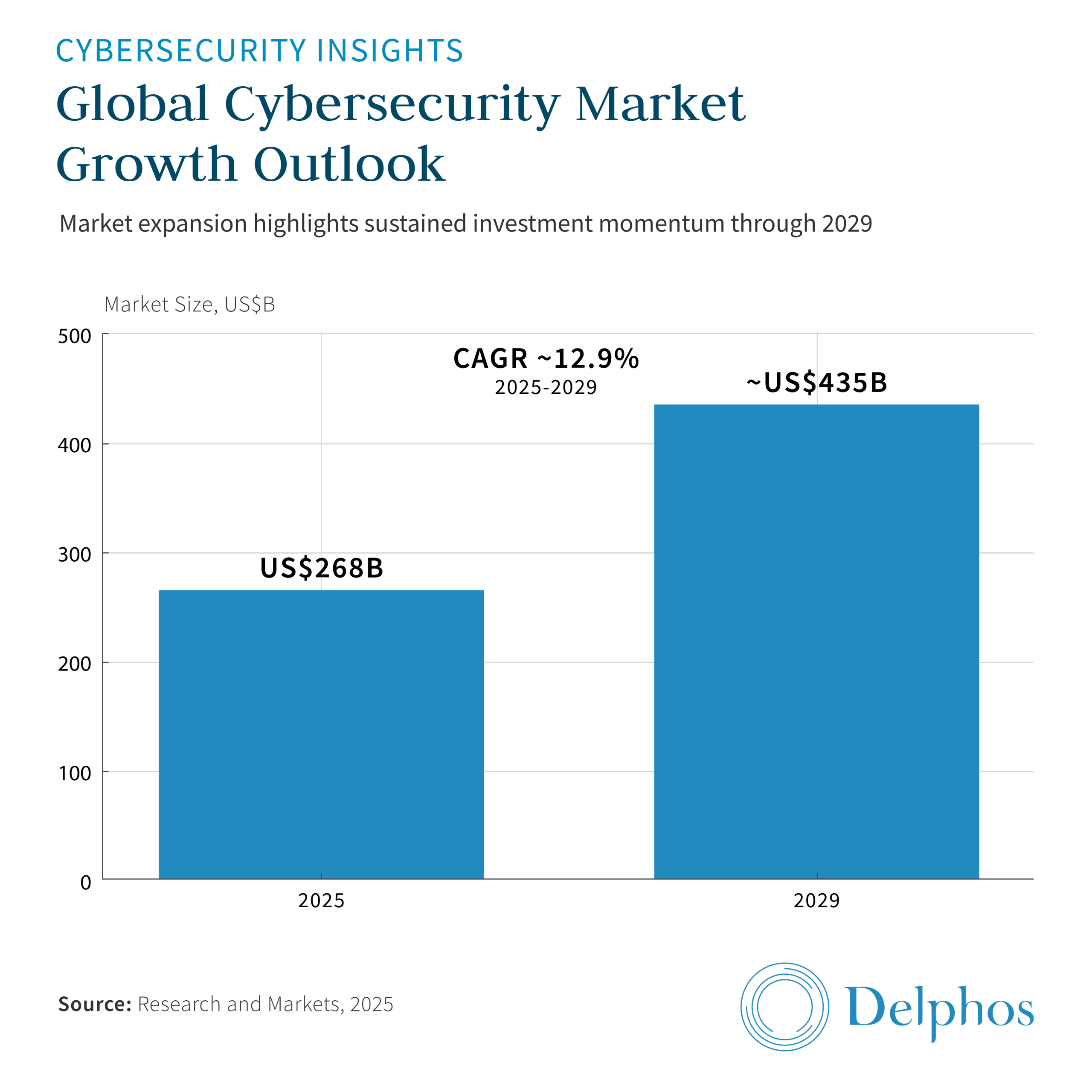 Developing a cybersecurity strategy for Emerging Markets requires a focused, pragmatic approach, and the capital flows underline why. The cybersecurity market is projected at US$267.5 billion in 2025, and VC resources of roughly US$5.1 billion YTD show where investors see urgency and upside. For 2026 cybersecurity investment 2026 readiness, organizations maintain disciplined execution across technologies:
Moreover, this is effective digital risk management: disciplined risk management that helps leadership manage risks, preserves economic growth and enterprise value, and makes digital risk management measurable.
Cyber exposure in Emerging Markets is uneven, and any cybersecurity strategy for Emerging Markets must account for sector-specific risk profiles. Financial institutions and fintech face elevated risk as transaction volumes scale rapidly. At the same time, energy, infrastructure, and telecoms confront growing threats to operational technology. Supply chains are another weak point. More than half of breaches in Emerging Markets originate with third-party vendors that lack adequate controls. For financial institutions, data breaches can affect customers, transactional databases, and sensitive information. These incidents can quickly escalate from operational disruptions into systemic data-confidence shocks for customers and markets.
In practice, concentrated suppliers and fragile dependencies turn security outages into material cybersecurity risks. This affects both new market entrants and incumbents. In these sectors, weak vendor controls become a systemic risk management problem. That makes third-party digital risk management and procurement risk management as important as perimeter defense.
For businesses in these sectors, a tailored cybersecurity strategy for Emerging Markets is a priority. It helps safeguard continuity and protect enterprise value during expansion.
By 2026, cyber resilience in Emerging Markets will be treated less as an IT metric. Leaders will use it as a proxy for execution risk. A credible cybersecurity strategy for Emerging Markets anchors that shift. Over 72% of investors now rank cyber resilience as one of their top-three investment criteria. At the same time, cybersecurity spending is rising 12.5% year-over-year. In emerging economies, regulatory enforcement and incident response can be uneven. This shifts cybersecurity from “cost” to commercial leverage and cyber resilience. In emerging economies, cyber maturity is increasingly underpinning economic growth. It shapes how businesses scale, how companies are valued, and whether management can stay ahead of operational shocks. Investors increasingly read digital risk management maturity as execution capability amid new technologies. They also expect risk management to be embedded in growth, not bolted on after incidents.
A robust cybersecurity strategy for Emerging Markets increasingly signals management quality. It reflects disciplined oversight, stronger security controls, and the ability to scale securely across borders and technologies. Organizations that embed digital risk management into cloud environments, supplier onboarding, and expansion planning reduce disruption risk. They also improve stakeholder confidence. A credible cybersecurity strategy for Emerging Markets is increasingly becoming a competitive differentiator for investors and management teams.
 Partner with Delphos for Cyber-Ready Market Entry
For more than 30 years, Delphos has supported investors, sponsors, and corporates in structuring transactions that mobilize capital, strengthen resilience, and advance sustainable development across emerging economies. We bring a practical cybersecurity strategy for Emerging Markets into the deal and expansion process, linking execution, compliance, operational readiness, and investor expectations.
Our advisory capabilities span Capital Raising, Transaction Advisory, Corporate Service Set Up, and Cybersecurity, giving clients the strategic and technical resources required to execute complex cross-border transactions with confidence.
Contact us to explore how Delphos can support your 2026 plan, process, and country-level execution with a cybersecurity strategy for Emerging Markets.
Editorial
November 9, 2026 - The Lobito Corridor shows how structure and route security, not commodity price, decide which African critical minerals projects reach close.

Editorial
November 2, 2026 - Emerging Markets debt repriced through Q3 2026, so sponsors must size the senior-debt slot against observed terms, not 2025 forecasts.

Editorial
October 27, 2026 - Emerging Markets sponsors match the supply chain finance instrument to their position in the chain and the constraint that binds.
Discover Delphos' premier capital raising and financial advisory services, making an impact across five continents.
Learn More
Reach out to us to enhance your impactful business in private emerging markets by Delphos' tailor-made financial advisory and capital raising service.
Learn More
Delphos arranges capital raising (debt and equity) and transaction advisory for emerging-market project sponsors and operating corporates across Africa, Asia, Latin America and the Caribbean, and Emerging Europe.
Thank you for submitting the form. Our team will reach out to you soon.
In the meanwhile follow us on LinkedIn to get inspired daily.
Visit LinkedIn
We appreciate your interest in Delphos!
Could you let us know how you discovered us?
We are here to help. Reach out to schedule an introductory call with one of our team members and learn more about how Delphos Cybersecurity can benefit your organisation.

Tell us a bit about your needs so we can match you with the right advisor.

Stay ahead on impactful stories and industry trends in private emerging markets - the knowledge you need is just a click away.
We appreciate your interest in Delphos!
Could you let us know how you discovered us?
 Top 5 Trends in Sustainable Infrastructure in Emerging Markets for 2026


