


Editorial
Best Emerging Markets to Invest in 2026: How Tariffs Redrew the Map
October 5, 2026 - Tariff access and near-shore capture reordered the 2026 Emerging Markets ranking, making bankability rather than forecast returns the deciding measure.
Editorial


Investors now apply an AI data screen before formal diligence begins, and sponsors without satellite-verified yield documentation are filtered out early.
AI-powered yield prediction achieves 85% to 95% accuracy, making it the evidence standard institutional lenders use to evaluate production risk in agriculture projects.
An investor-ready agriculture investment memo requires six components: project overview, AI-verified production data, a stress-tested financial model, off-take structure, capital stack design, and IFC-aligned ESG documentation.
Blended finance structures, where DFI participation reduces commercial lender exposure, are the most effective instrument for agri-business project developers seeking competitive tenor and credit terms.
Sponsors who complete the full preparation sequence before approaching the market face fewer conditions, shorter diligence cycles, and better pricing than those who arrive unprepared.
This guide is written for established agri-business sponsors in Latin America (LATAM), Africa, and Southeast Asia (SE Asia), preparing for a capital raise. Capital raising for agriculture projects now requires AI-verified yield data and a structured production records room as baseline investor expectations. Sponsors with three to five years of operations who cannot meet that standard are being filtered out before formal diligence begins.
This process involves an established agri-business sponsor securing institutional debt, equity, or blended finance from Development Finance Institutions (DFIs), development banks, or private capital providers to fund expansion, infrastructure, or working capital requirements.
 Capital providers now treat AI-screened production data as a baseline condition, not a differentiator. Agri-business sponsors who arrive without satellite-monitored yield histories and AI-generated forecasts cannot secure financial backing from institutional lenders and are screened out before a first meeting occurs.
The screen did not originate in agriculture. Funding partners applying algorithmic screening criteria across technology, energy, and logistics portfolios began applying the same standard to agriculture investment in Emerging Markets, a shift shaped by geopolitical risk and trade disruption that accelerated capital concentration into data-verified deals.
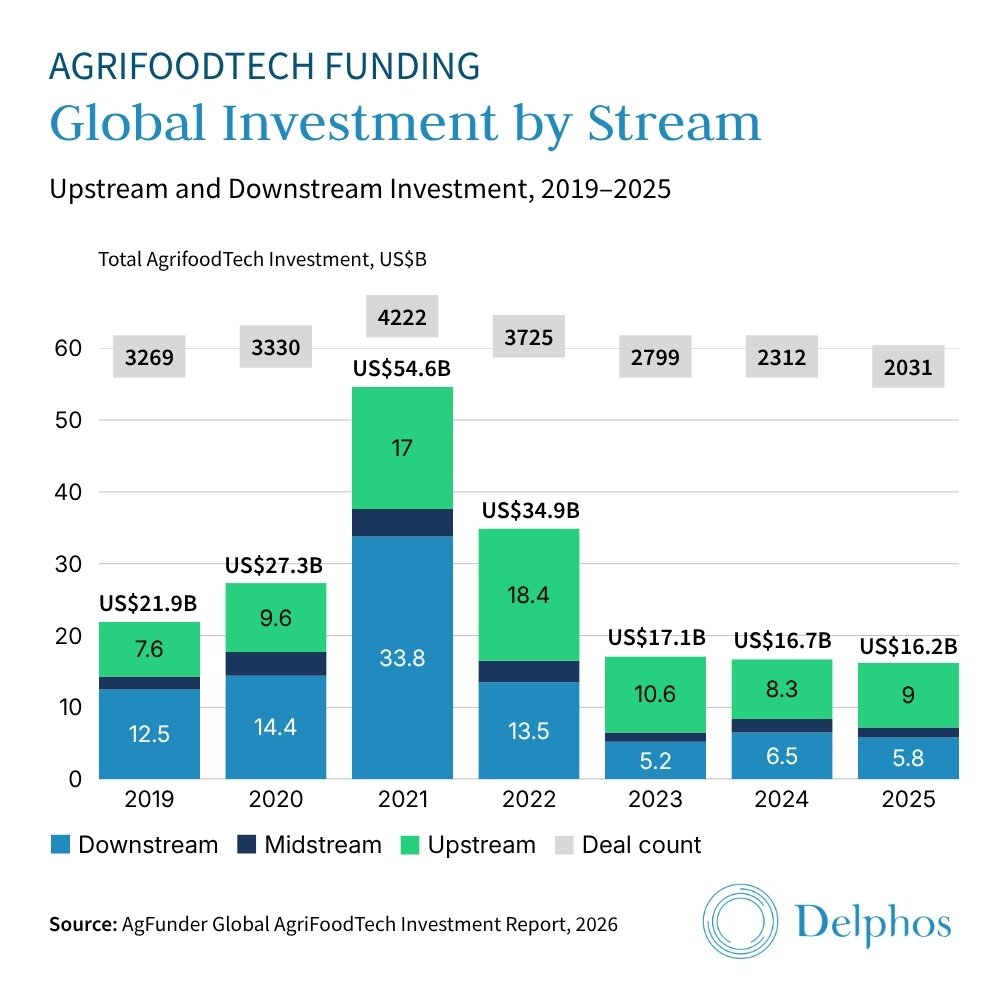
Agrifoodtech investment in developing markets reached US$3.7B in 2024, surging 63% year over year, while global agrifoodtech funding declined 4%. Sponsors preparing agricultural financing structures for LATAM exporters face the same documentation threshold as counterparties in Africa and SE Asia.
That divergence led institutional capital providers to invest in the sector, including DFIs with explicit economic development mandates, alongside rigorous diligence standards and consistent screening criteria.
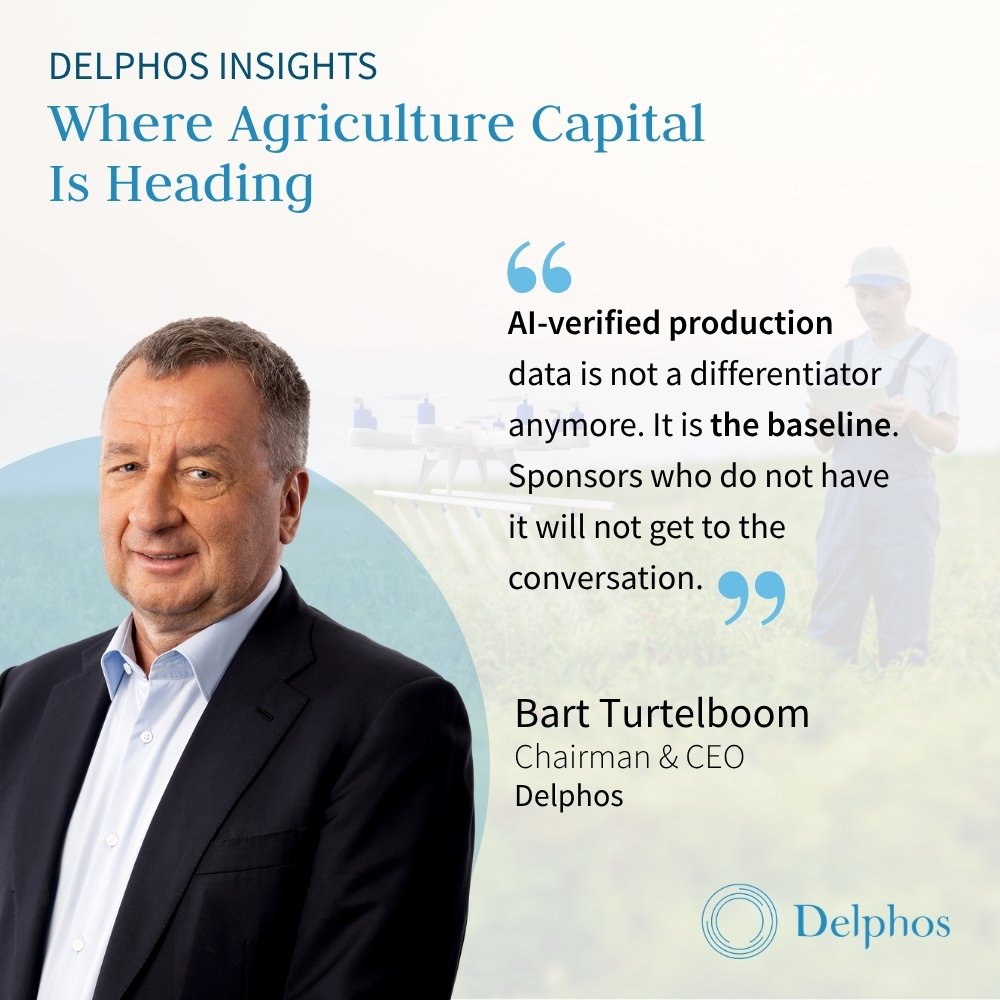
“Investors are not rejecting agriculture projects because of the sector. They are rejecting them because the data is not there when they need it.” – Bart Turtelboom, CEO of Delphos.
163 AgTech startups raised US$1.89B in Q1 2026, yet agriculture accounted for just 0.57% of total global venture capital deployed that quarter. Lenders focus capital on AI-integrated deals, with an average round size of US$11.6MM. The sponsors in those transactions were prepared. The broader capital raising in the Emerging Markets environment confirms the same pattern across all sectors.
 Satellite-monitored Normalized Difference Vegetation Index (NDVI) readings, AI-generated crop forecasts covering at least two full growing seasons, and a third-party validation certificate are the minimum standard institutional counterparties now apply. Self-reported yield figures, however accurate, cannot be independently replicated, and investors will not anchor a financial model on data they cannot confirm.
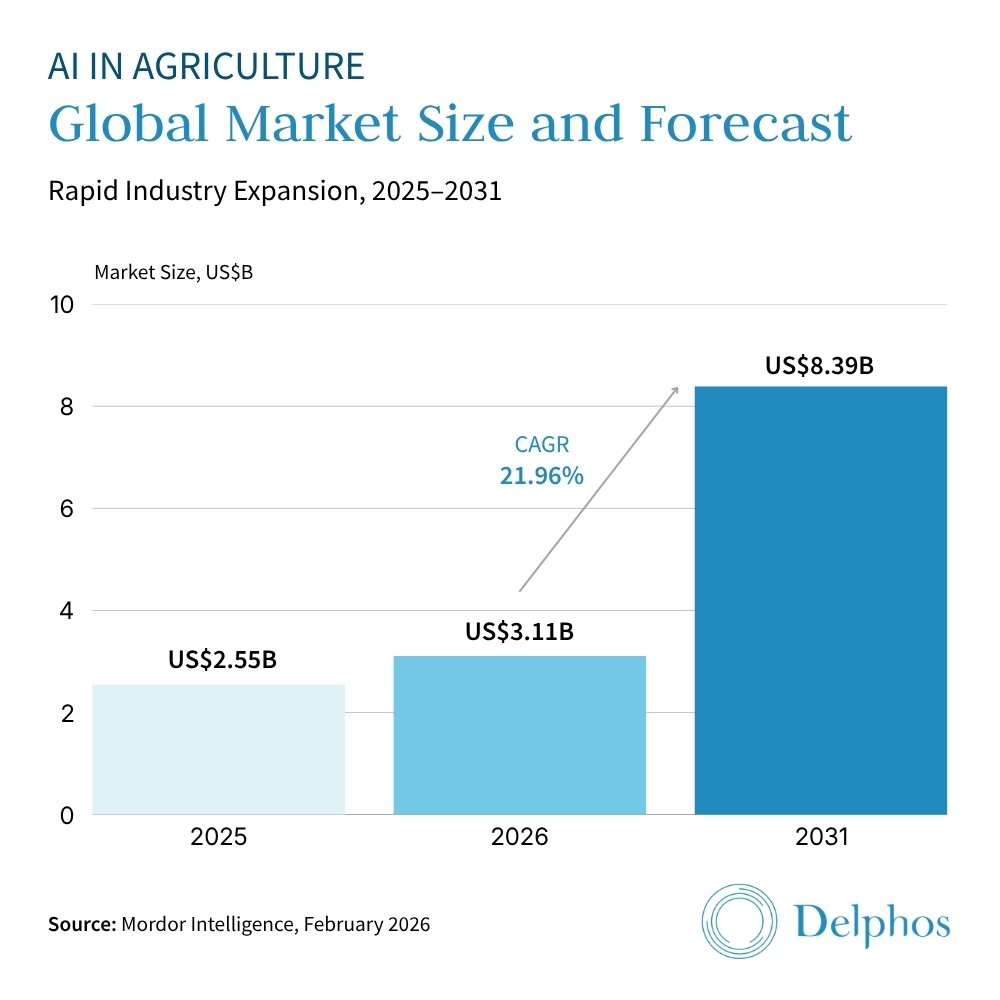
AI-powered yield prediction systems achieve accuracy rates of 85% to 95%, compared to 60% to 70% for traditional methods, with the best-performing models explaining 92% of crop yields variation. That gap determines whether an investor builds a financial model around a sponsor’s food production history or applies a discount for data uncertainty. Satellite monitoring directly measures agricultural productivity across growing seasons, generating a continuous, independently confirmed record that exists outside the sponsor’s own reporting chain.
The technological innovation enabling this shift, satellite-monitored NDVI platforms replacing self-reported data, is now commercially available across all three target regions. The minimum information package for investor presentation covers at least two full growing seasons of satellite-monitored field data, an AI-generated crop forecast with documented methodology, and a third-party validation certificate. That package does not replace the financial model. It anchors it.
Successful agriculture project financing depends on six components that institutional lenders evaluate before advancing any process: project overview, AI-verified production data, a stress-tested financial model, off-take structure, capital stack design, and ESG and governance documentation. Missing any one of them, or presenting a component that does not meet institutional standards, creates conditions that slow due diligence or terminate a process before it advances.
DFIs evaluate six components before advancing any agri-business project through formal diligence:
The project overview must present specific figures, not narrative descriptions. DFI project readiness standards require that financial projections hold under each stress scenario without covenant breach, with every assumption documented, including commodity price shocks and weather events.
Only 14 of 91 IFC agribusiness projects reviewed from FY22 to FY25 deployed risk capital, with an average deal size of US$57.6MM, that selectivity reflects documentation standards, not sector reluctance. The World Bank Group’s commitment to US$9B annually by 2030 targets agricultural development, food security outcomes, and food systems strengthening, including explicit targets for smallholder farmers and rural communities, confirming that capital is available for sponsors who meet the documentation standards DFIs require for rural development and food security investments. The memo is the filter. The data room is where the resources DFIs require (confirmed yield data, stress-tested financial models, and ESG documentation) are assembled before the process begins.
Off-take contracts or demonstrated supply chain diversification reduce revenue concentration risk. ESG documentation aligned to IFC Performance Standards is a non-negotiable requirement for DFI review. Operators targeting DFI capital increasingly need to advance sustainable agricultural practices and document climate change resilience measures as part of their ESG submission and as a standalone criterion in DFI credit assessment. DFIs also conduct independent research on project viability and extend technical assistance to agri-business operators who demonstrate preparation readiness, making data room quality a determinant of the advisory support available, not just the financing.
DFI-backed financial products, including structured debt and blended finance instruments, now account for 18.2% of total agrifoodtech funding in 2025, its highest share in a decade. That capital is explicitly mandated to support food security outcomes, rural development, and climate-resilient agricultural systems. The increase reflects lender appetite, not just sponsor preference. Understanding blended finance structures and lender requirements in Emerging Markets is now a prerequisite to addressing a sponsor’s financing needs with a capital stack that capital providers can engage with. The three most relevant structures are project finance facilities sized against AI-verified harvest data and off-take contracts, blended finance structures where DFI participation absorbs the first-loss tranche and enables private investor participation, and A/B loan structures providing longer tenor and preferred creditor protections. DFI partial credit guarantees and credit enhancement instruments are also available to reduce commercial lender risk exposure in first-time transactions. The capital stack section of the memo must specify the chosen instrument, the rationale, and how debt service aligns with the operational ramp-up timeline.
 Delphos has structured agriculture and agribusiness transactions across LATAM, Africa, and SE Asia for more than three decades, with an extensive cross-regional track record. The following transactions illustrate how companies across diverse geographies applied these preparation disciplines to reach financial close:
Delphos has structured agriculture and agribusiness transactions across the agricultural sector in Emerging Markets for more than 38 years. With over 600 completed transactions and more than US$20B mobilized, the firm supports sponsors navigating complex operating environments across Latin America, Sub-Saharan Africa, and Southeast Asia.
Through its integrated Capital Raising and Transaction Advisory services, Delphos guides agribusiness sponsors through the full preparation process, from AI-verified data and investment memo development to capital stack design and lender engagement strategy.
Speak With The Delphos Team To Begin Your Capital Raising Preparation →
Institutional investors and DFIs apply four baseline screening criteria before formal diligence begins: AI-verified yield data covering at least two satellite-monitored seasons, a structured investment memo with stress-tested financial scenarios, a capital stack design incorporating blended finance instruments, and ESG documentation aligned to IFC Performance Standards.
AI-powered yield prediction achieves 85% to 95% accuracy versus 60% to 70% for traditional methods. Satellite-verified NDVI data is independently verifiable and continuously updated, which reduces investor uncertainty, lowers the number of conditions attached to term sheets, and shortens diligence cycles for prepared sponsors.
The core difference is the evidence standard. Traditional memos relied on self-reported yield data and optional ESG summaries. AI-era memos require satellite-verified production data, stress-tested financial models, layered capital structures, and ESG documentation aligned to development finance governance standards. The gap between the two is where most sponsors lose deals.
DFIs assess financial model robustness across stress scenarios, governance and environmental compliance aligned to IFC Performance Standards, capital stack design demonstrating blended finance readiness, and off-take structure or supply chain diversification. Sponsors who cannot demonstrate all four criteria are typically declined before a term sheet is issued.
Three structures are most relevant: project finance facilities sized against AI-verified production data and off-take contracts, blended finance structures where DFI participation absorbs first-loss exposure and enables private capital participation, and A/B loan structures providing longer tenor and preferred creditor protections.
Sponsors with two or more seasons of satellite monitoring data, audited financials, and governance documentation in place can prepare an investor-ready memo in four to eight weeks with advisory support. Sponsors starting from scratch typically require three to six months. Preparation quality directly affects the terms available at close.
DFI financing standards are consistent across Latin America, Sub-Saharan Africa, and Southeast Asia. IFC, the World Bank Group, and regional DFIs apply identical preparation requirements regardless of geography. The World Bank Group's US$9B annual agribusiness commitment by 2030 covers all three regions under the same documentation threshold.
Editorial
October 5, 2026 - Tariff access and near-shore capture reordered the 2026 Emerging Markets ranking, making bankability rather than forecast returns the deciding measure.

Editorial
September 21, 2026 - Telecom financing in frontier markets closes when one US$ instrument prices currency, tenor, and geopolitical risk inside a single structure.

Editorial
September 14, 2026 - DFI financing goes to the sponsor a development lender can defend to its risk committee, not the highest projected return.
Discover Delphos' premier capital raising and financial advisory services, making an impact across five continents.
Learn More
Reach out to us to enhance your impactful business in private emerging markets by Delphos' tailor-made financial advisory and capital raising service.
Learn More
Delphos arranges capital raising (debt and equity) and transaction advisory for emerging-market project sponsors and operating corporates across Africa, Asia, Latin America and the Caribbean, and Emerging Europe.
Thank you for submitting the form. Our team will reach out to you soon.
In the meanwhile follow us on LinkedIn to get inspired daily.
Visit LinkedIn
We appreciate your interest in Delphos!
Could you let us know how you discovered us?
We are here to help. Reach out to schedule an introductory call with one of our team members and learn more about how Delphos Cybersecurity can benefit your organisation.

Tell us a bit about your needs so we can match you with the right advisor.

Stay ahead on impactful stories and industry trends in private emerging markets - the knowledge you need is just a click away.
We appreciate your interest in Delphos!
Could you let us know how you discovered us?


