


Editorial
Best Emerging Markets to Invest in 2026: How Tariffs Redrew the Map
October 5, 2026 - Tariff access and near-shore capture reordered the 2026 Emerging Markets ranking, making bankability rather than forecast returns the deciding measure.
Editorial


AI underwriting now creates a tier of bankable Emerging Markets companies that traditional credit committees cannot evaluate through standard financial records.
Tariff escalation has made the move to non-bank lending permanent, redirecting cross-border and export-linked Emerging Markets issuers away from contracting bank credit.
EM private debt carries 3x to 4x leverage and sub-40% loan-to-value ratios, with structural protections that US direct lending no longer guarantees.
Sponsors who align documentation and governance with private debt manager standards close faster than they would through tightening bank channels.
Fund managers with AI underwriting capabilities reach a larger EM private debt pipeline than earlier vintages produced.
Private credit in Emerging Markets 2026 has reached a structural turning point. This analysis serves two readers at once: mid-market sponsors seeking non-bank debt, and institutional fund managers weighing where to allocate EM credit. Artificial intelligence (AI) underwriting has expanded the bankable borrower universe, while tariff-induced bank retrenchment has permanently redirected mid-market demand toward non-bank lending.
Private credit is direct lending from institutional fund managers to companies, structured as term loans, credit facilities, or asset-backed finance that bypasses commercial banks and public financial markets. These managers set their own documentation and governance standards rather than applying conventional regulatory underwriting criteria.
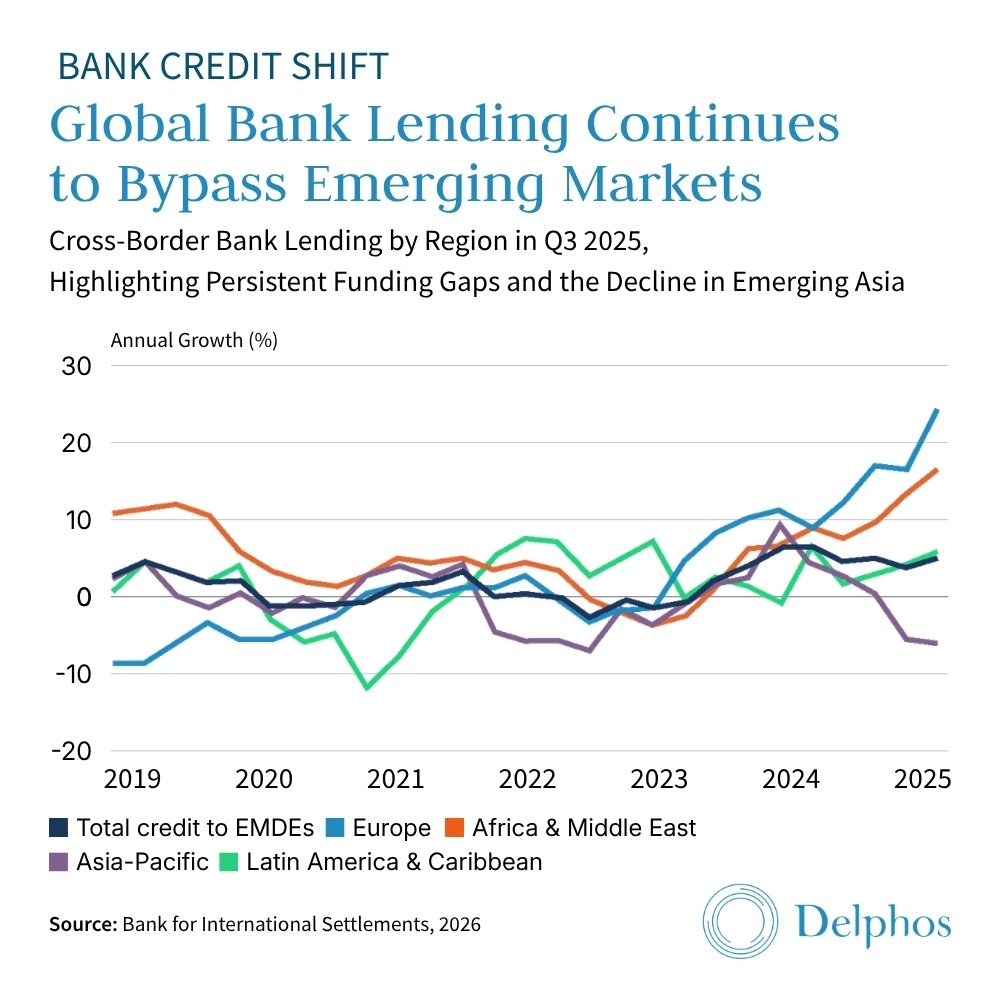 The shift is structural: non-bank credit has replaced bank lending as the primary debt channel for mid-market EM companies in 2026. Two forces converged. Post-2023 capital requirements, the latest in a tightening arc that began after the global financial crisis, cut commercial bank appetite for issuers needing US$5MM to US$50MM, set against trade-induced credit contraction. Lenders built the origination and underwriting infrastructure to serve this segment at scale.
The capital flows confirm the shift. Assets in the asset class recorded rapid expansion, increasing fivefold over the past decade to between US$50B and US$100B. Nonbanks now supply 80% of the region’s capital inflows, twice their share two decades ago, and portfolio debt liabilities average 15% of Emerging Markets GDP, up from 9% in 2006. The structural case for EM private credit predates this credit cycle, yet private credit in Emerging Markets 2026 now serves companies that banks cannot reach at speed.
Bank credit has thinned at the wholesale level. In Bank for International Settlements (BIS), which compiles central bank data, cross-border lending to all emerging market and developing economies (EMDEs) expanded by only US$70B, set against US$284B flowing to the United States in Q3 2025. Capital rules introduced after 2023 raised the cost of holding mid-market exposure on bank balance sheets. The issuers most affected are the three- to five-year-old corporates that standard bank models struggle to score and that non-bank credit pipelines are now structured to reach.
Private debt fills the space banks have vacated, and direct lenders alongside allocators have moved with it. Global private debt reached US$1.5T to US$2T in assets at end-2024, a scale now drawing financial stability scrutiny, with the region at only US$50B to US$100B, roughly 4% to 6% of the global asset class. That small share is the opening as institutional investors, including pension funds and other allocators, rotate further into private markets. 81% of limited partners (LPs) surveyed in November 2025 plan to hold or increase their private debt commitments through 2026, rising to 89% over the longer term.
What lets lenders reach companies that banks cannot assess is a newer underwriting method.
The capital base is also changing shape, and the market outlook for 2026 reflects it. Assets in evergreen private debt funds reached US$644B by mid-2025, of which roughly US$520B sits in private wealth-focused fund structures. Allocators now reach the asset class through evergreen funds, BDCs, and interval structures that channel private wealth into middle market lending.
Several of the largest firms expect wealth-sourced assets to reach 50% of their capital, and the largest listed managers hold about US$1.7T in permanent capital, around 41% of their assets, while European fundraising hit a record US$65B in the first nine months of 2025 as firms worked to attract capital.
This widens the pool of private assets and private wealth that can reach EM exposure, though most evergreen vehicles concede that liquidity is managed, not intrinsic: redemptions price at net asset value and sit behind gates that create liquidity constraints when many investors exit at once.
 AI underwriting enables non-bank lenders to assess Emerging Markets companies without standard financial records, deploying machine learning that reads alternative data. Satellite imagery of physical assets, mobile payment volumes, and supply chain signals generate credit assessments that substitute for or supplement three years of audited accounts.
The method expands deal origination reach to issuers that commercial banks have historically declined. The same data infrastructure supports portfolio monitoring, giving non-bank lenders early warning of cash flow stress and credit deterioration before covenant triggers are reached. These systems can flag deviations in borrower performance indicators and detect negative sentiment in borrower communications before formal default signals appear.
The infrastructure behind algorithmic credit assessment in this borrower segment is already built. 448 alternative credit scoring firms now operate globally, more than 75% founded in the past decade. The common inputs are unstructured data from mobile money, digital wallets, point-of-sale systems, call and SMS metadata, and geolocation, and data quality determines whether these inputs produce bankable credit assessments. About 60% of these firms supply scoring and lending software to financial institution partners rather than lending directly, embedding credit risk assessment in existing workflows.
Which EM companies qualify for machine-learning underwriting, and therefore become accessible to deal sourcing teams, follows from what the models can read. Issuers with digital revenue trails come first, particularly those in digital lending and payments operators, consumer platforms, and logistics firms whose flows are machine-readable. The addressable pool is large. 70% of micro, small, and medium enterprises (MSMEs) in Emerging Markets lack adequate financing, and the formal MSME gap in EMDEs runs to US$5.2T a year.
The redirection already shows in cross-border flows. In BIS figures, commercial lending to emerging Asia declined 6% year on year at the end of Q3 2025, while non-bank financial institution (NBFI) lending expanded 13%.
“The transactions we are closing in 2026 reach borrowers that bank credit committees could not approve three years ago. AI-powered underwriting has permanently expanded the EM deal pipeline.”
– Bart Turtelboom, Chairman & CEO of Delphos.
Supply is only half the story. A second force is pushing existing bank clients toward non-bank options.
Tariffs reduce EM issuers’ access to bank credit by raising the revenue volatility that standard credit models penalize. Cross-border and export-linked companies draw higher default estimates under trade conditions that conventional lenders find hard to price. Non-bank lenders who build trade-disruption analysis into their structuring, rather than applying bank criteria, close the transactions banks now decline.
Trade fragmentation withdraws bank capacity where non-bank credit is needed most. The global trade finance gap doubled to US$2.5T between 2017 and 2025, with Emerging Markets the most affected. Tariffs add direct pressure on companies exporting to the United States and indirect pressure through slower growth, softer commodity prices, weaker currencies, and rising investor caution across nearly every Emerging Markets sector. As confidence falls, commercial lenders meet lower loan demand and greater strain on existing repayment capacity, and they tighten further.
What private credit firms require differs from bank criteria and the financial models banks rely on, and the difference favors prepared issuers. These institutions set their own documentation and governance standards and conduct independent due diligence, so companies that study what lenders require from EM sponsors can align before the first meeting. Currency exposure sits near the top, which is why the currency structure of EM debt transactions shapes pricing under tariff-induced volatility. The discipline shows in the figures: Emerging Markets borrowers in private credit carry leverage of 3x to 4x against 6x to 7x in developed market corporate direct, with loan-to-value (LTV) ratios on the underlying assets below 40% versus 50% to 60% in developed markets. The combined effect of low leverage and sub-40% LTV is structural downside protection that compensates for the higher information asymmetry that conventional financial models cannot price.
The market has matured on the lender side, too. Private debt has exceeded broadly syndicated loan issuance for B-rated and lower issuers for four consecutive years, reaching approximately US$146B in 2025 against US$85B in broadly syndicated lending. The US direct lending market carries a concentration that the region avoids: by some estimates, software borrowers account for 40% of all sponsor-backed loans. In the US, private debt rose from about US$8B in 2015 to over US$500B, 19% of direct loans, by end-2025, with one-third of funds holding that exposure.
Set side by side, the EM asset class and US direct lending diverge on leverage, loan-to-value, yield, covenant protection, sector exposure, alternative data acceptance, and scale. These ratios describe the asset class in aggregate. The transaction record shows the structuring at the deal level.
 These Emerging Markets private credit structures are not theoretical. They run through the company’s track record across Emerging Markets, spanning three regions and three borrower profiles.
Two structural forces now define the market: AI underwriting-led borrower access and tariff-induced bank retrenchment. For established EM sponsors seeking non-bank debt, Capital Raising structures and arranges private debt facilities and connects them to the institutional lenders whose standards this analysis has described. For fund managers building EM exposure, Transaction Advisory assesses borrower viability and builds capital structures to institutional requirements, supported by 38+ years of execution across 100+ countries.
Contact the Delphos team to align your transaction with institutional private credit requirements →
Private credit is direct, non-bank lending from institutional fund managers to mid-market companies, structured as term loans or credit facilities outside commercial banks and public markets. Managers set their own documentation and governance standards. In Emerging Markets, it is increasingly the primary channel for issuers between US$5MM and US$50MM.
Post-2023 capital requirements and trade-related credit contraction have reduced bank appetite for Emerging Markets mid-market issuers. Tariff escalation compounds the pressure by raising revenue volatility estimates for cross-border and export-linked companies under standard credit models, making approval harder regardless of underlying credit quality.
Machine learning models analyze alternative data, including mobile money records, digital payment volumes, supply chain signals, geolocation data, and utility payment patterns, to generate credit risk profiles for companies with limited formal documentation. These models substitute for or supplement three years of audited accounts and operate across 400+ firms globally.
Three requirements dominate. Governance documentation includes audited accounts or equivalent alternative data, ownership structure, and board composition. Capital stack alignment means leverage near 3x to 4x and clear collateral. Funds also weigh impact or environmental, social, and governance (ESG) evidence where the mandate requires it.
Not by the standard structural measures. EM issuers typically carry 3x to 4x leverage against 6x to 7x in US direct lending, with loan-to-value ratios below 40% versus 50% to 60% in developed markets. Senior secured positioning is standard.
Tariff escalation pressures credit access two ways. Companies exporting to the United States face less predictable revenue, raising default estimates in standard credit models. Broader slowdown, currency volatility, and weaker investor confidence reduce commercial lending appetite across sectors. Both effects create heightened demand for managers who price these risks explicitly.
Private credit transactions for mid-market sponsors typically combine borrower viability assessment, capital structure design, and alignment with institutional documentation and governance standards. Sponsors who organize financial records and ownership structure before approaching managers close faster than those who do not. Currency and collateral terms are negotiated early, since these drive pricing more than headline leverage.
Editorial
October 5, 2026 - Tariff access and near-shore capture reordered the 2026 Emerging Markets ranking, making bankability rather than forecast returns the deciding measure.

Editorial
September 21, 2026 - Telecom financing in frontier markets closes when one US$ instrument prices currency, tenor, and geopolitical risk inside a single structure.

Editorial
September 14, 2026 - DFI financing goes to the sponsor a development lender can defend to its risk committee, not the highest projected return.
Discover Delphos' premier capital raising and financial advisory services, making an impact across five continents.
Learn More
Reach out to us to enhance your impactful business in private emerging markets by Delphos' tailor-made financial advisory and capital raising service.
Learn More
Delphos arranges capital raising (debt and equity) and transaction advisory for emerging-market project sponsors and operating corporates across Africa, Asia, Latin America and the Caribbean, and Emerging Europe.
Thank you for submitting the form. Our team will reach out to you soon.
In the meanwhile follow us on LinkedIn to get inspired daily.
Visit LinkedIn
We appreciate your interest in Delphos!
Could you let us know how you discovered us?
We are here to help. Reach out to schedule an introductory call with one of our team members and learn more about how Delphos Cybersecurity can benefit your organisation.

Tell us a bit about your needs so we can match you with the right advisor.

Stay ahead on impactful stories and industry trends in private emerging markets - the knowledge you need is just a click away.
We appreciate your interest in Delphos!
Could you let us know how you discovered us?


